Buying Guide · 10 min read
2014 Subaru Outback: Final Gen-4, Best Sorted
Final year of the fourth generation, with wider EyeSight availability and above-average Consumer Reports reliability — the one to buy from this generation.
By Elena Marsh · · Updated
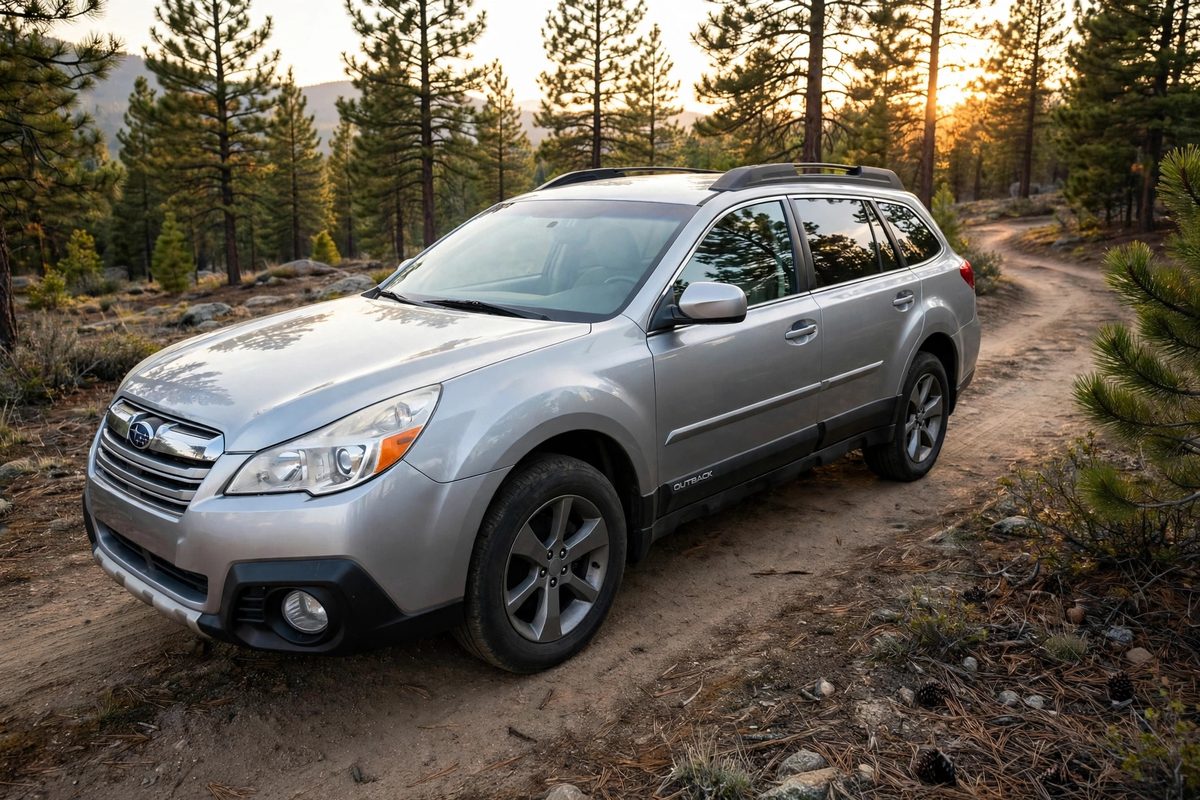
The 2014 Subaru Outback is the final year of the fourth generation, and the one to buy if you want that generation at its most complete: wider EyeSight availability, Aha smartphone integration, and everything that made the wagon popular — standard all-wheel drive, seating for five, 8.7 inches of clearance, and 71.3 cubic feet of maximum cargo space. Kelley Blue Book's current dealer Fair Purchase Prices start at about $8,350, and the car earned both a 5-star overall NHTSA rating and the IIHS Top Safety Pick+ award. The warning carries over from 2013: the FB25 four-cylinder is linked to oil consumption reports, so the same careful checks apply. Buy one that passes them, and the 2014 is arguably the best-value fourth-generation Outback.
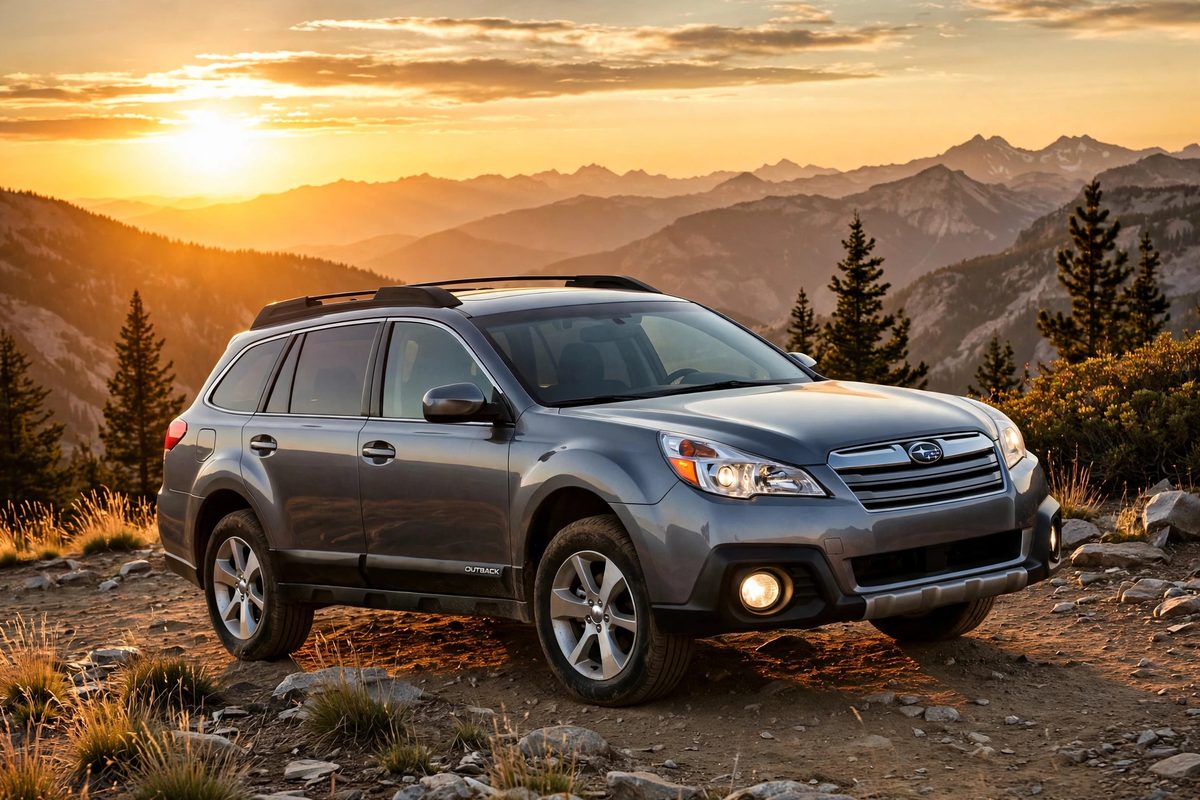
2014 Subaru Outback at a Glance
| What to know | 2014 Outback |
|---|---|
| Starting price when new | $23,495 for the base 2.5i (CARFAX) |
| Current used starting price | About $8,350 (Kelley Blue Book) |
| Engines | 2.5-liter flat-four, 173 hp; 3.6-liter flat-six, 256 hp |
| Fuel economy | 24 city / 30 highway mpg (2.5-liter, CVT); 18 / 25 mpg (3.6-liter) |
| Drivetrain | Standard Symmetrical All-Wheel Drive |
| Towing | Up to 3,000 pounds (3.6-liter) |
| Cargo | 34.3 cubic feet behind rear seats; 71.3 folded |
| Ground clearance | 8.7 inches |
| Safety | IIHS Top Safety Pick+; 5-star overall NHTSA rating; EyeSight available |
Why the 2014 Model Year Matters
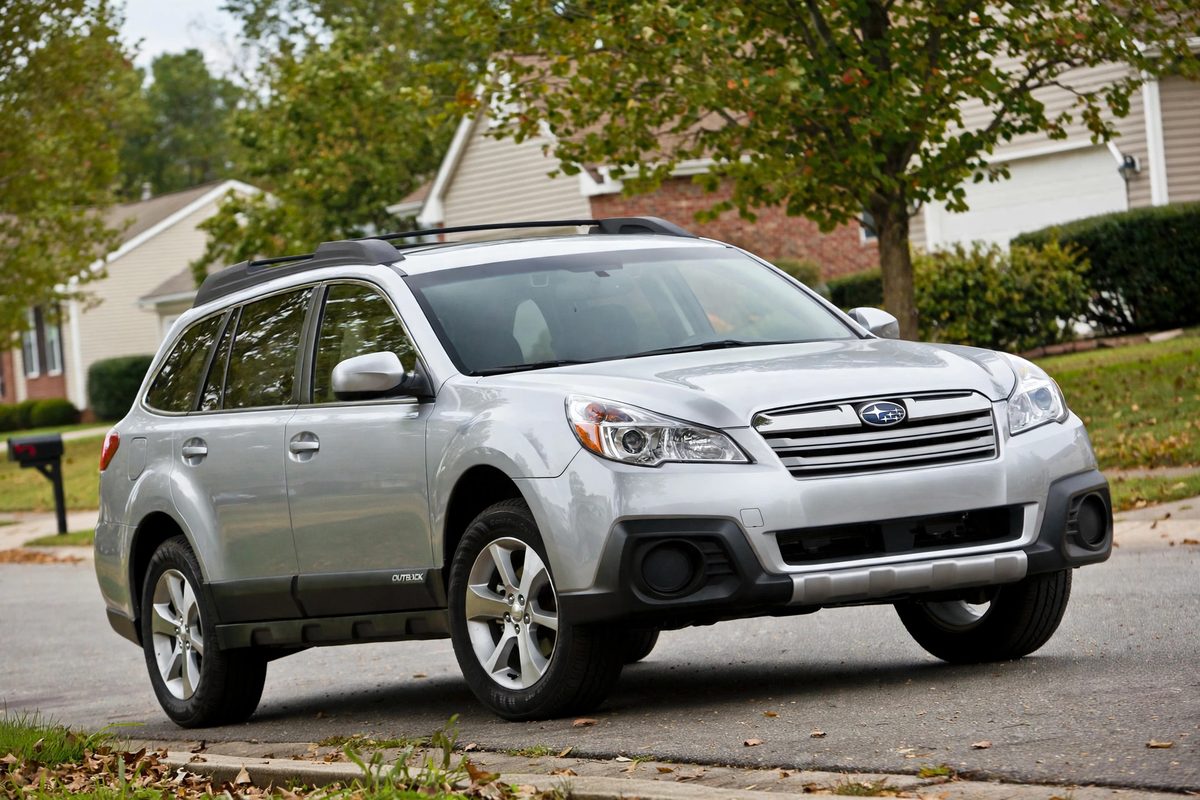
The 2014 Outback closes out the fourth generation, which began in 2010 with a larger body, a longer wheelbase, and far more rear-seat room than the wagon it replaced. By 2014 the formula was fully sorted, and Subaru widened the technology: EyeSight (adaptive cruise control, pre-collision braking, lane departure warning) became available on more trims, and Aha smartphone integration joined the options list. Subaru's 2014 announcement stresses the same core pitch: standard all-wheel drive where most crossovers charge extra, 8.7 inches of clearance, and a roomy interior in an easy-to-manoeuvre wagon.
A second reason the 2014 stands out: Consumer Reports rated it above average for reliability, while the 2010 to 2013 cars were rated average, and CarGurus records a 4.67 out of 5 owner rating. Neither figure erases the oil consumption reports below, but together they explain why the 2014 typically costs a little more than the 2013 and is often worth it.
Prices and Trims: What Each Version Cost
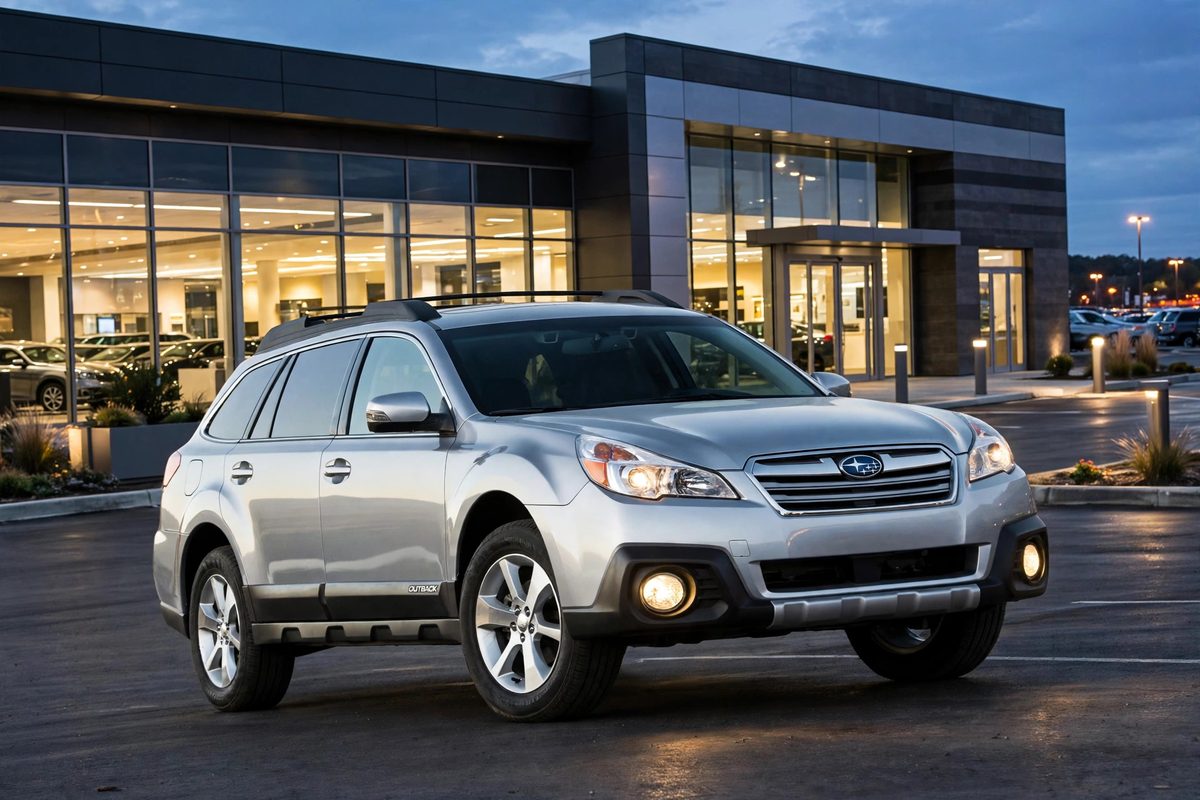
The 2014 Outback came in four trims, all with all-wheel drive — one fewer than 2013, because the non-Limited 3.6R was dropped. The table below pairs each trim's original price with Kelley Blue Book's current Fair Purchase Price, which reflects typical-condition dealer sales and is updated weekly. Individual cars vary widely with mileage, condition, and location, so treat these as starting points, not quotes for a specific car.
| Trim | Original MSRP | Current used starting price |
|---|---|---|
| 2.5i | $26,086 | $8,625 |
| 2.5i Premium | $27,920 | $8,350 |
| 2.5i Limited | $30,347 | $9,150 |
| 3.6R Limited | $32,920 | $10,150 |
As a cross-check, CARFAX puts the average marketplace price at about $9,578, with an original MSRP range of $23,495 to $32,095. Two things stand out in the Kelley Blue Book figures. First, the Premium is again the value pick: it starts lower than the base car today while adding alloy wheels, fog lights, and a power driver seat. Second, the step to the six-cylinder Limited is only about $1,000 used, making it a tempting upgrade for towing. A November 2026 check of CarGurus national listings agrees with the Kelley Blue Book band: about 1,185 cars listed at an average of roughly $8,620, down about 7% on a year ago.
Engines, Performance and Real-World Driving
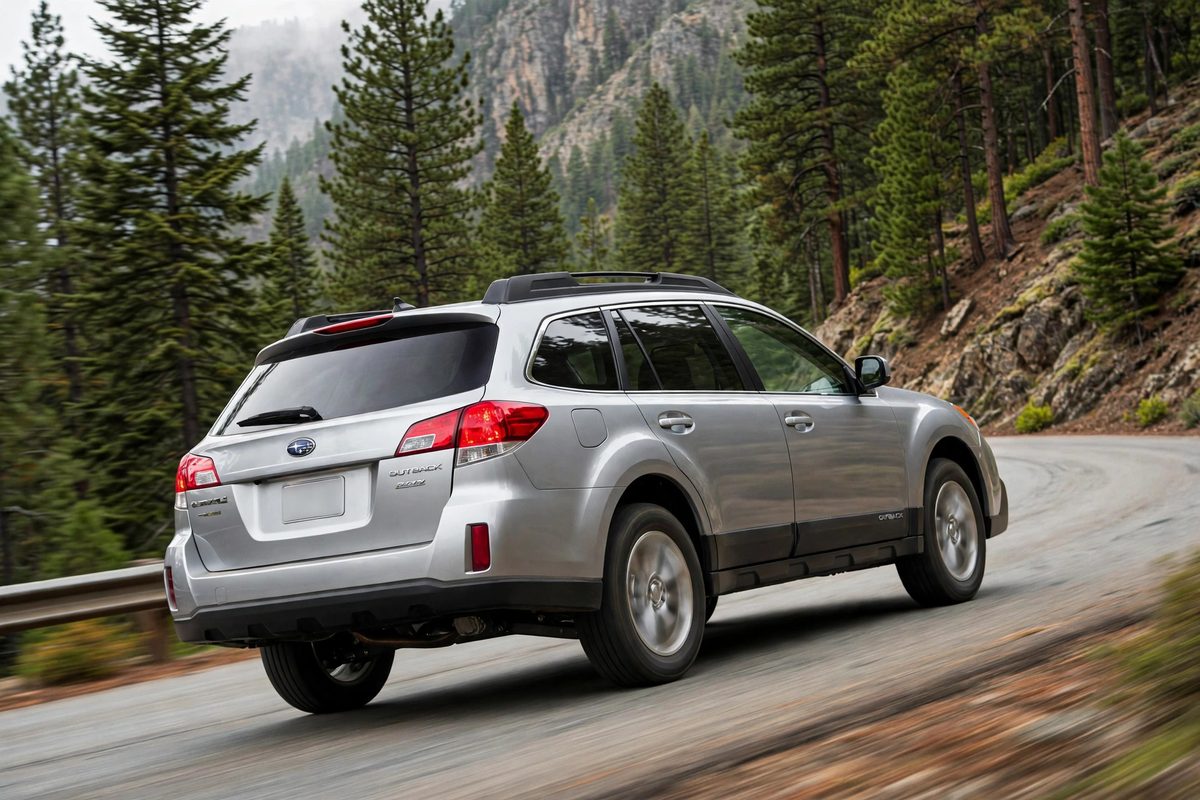
The base 2.5-liter flat-four makes 173 horsepower and 174 lb-ft of torque, paired with either a six-speed manual on the base trim or Subaru's Lineartronic CVT. The CVT is the economy choice: 24 mpg in the city and 30 on the highway, or 26 combined, against 21 and 28 for the manual. Kelley Blue Book notes the four-cylinder has to work a bit when pressed, but at cruising speed the CVT holds peak torque well, and with an 18.5-gallon tank the CVT car can cruise well over 500 miles between fill-ups.
The 3.6-liter flat-six makes 256 horsepower and 247 lb-ft of torque and comes only with a five-speed automatic with shift paddles. It is the more refined choice, with stronger passing power and a 3,000-pound towing limit. The trade-off is fuel economy, at 18 mpg in the city and 25 on the highway. On the road, all-wheel drive and 8.7 inches of clearance handle snow, gravel, and rutted tracks that stop most family wagons, though guides note the taller body is sensitive to strong side winds.
Interior, Cargo and Everyday Practicality
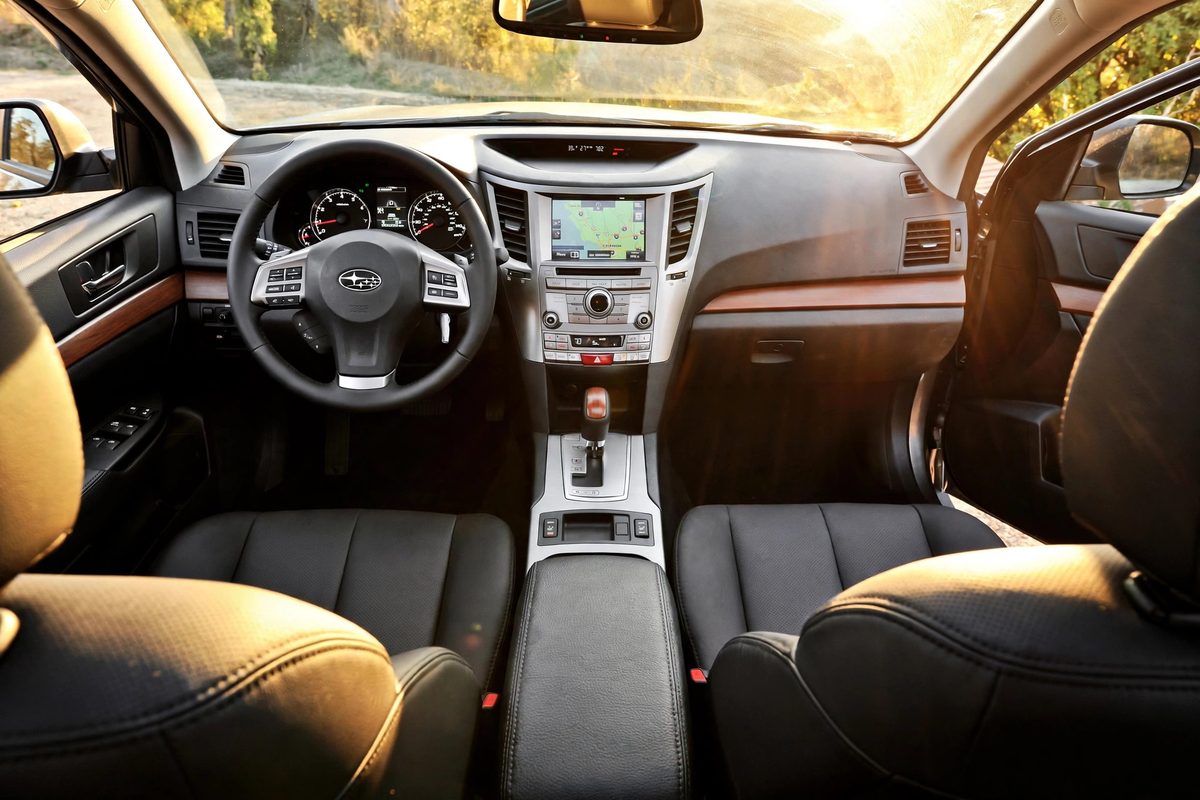
Inside, the 2014 Outback seats five in a roomy cabin with 105.4 cubic feet of passenger volume. You get 34.3 cubic feet behind the rear seats and 71.3 cubic feet with the rear seats folded, more than a 2014 Honda CR-V by CARFAX's comparison, and the standard foldable roof crossbars swing inward to double as a rack. Base and Premium use cloth; Limited trims use leather with heated front seats and dual-zone climate control. Technology is basic by today's standards — no CarPlay or Android Auto — but wider EyeSight availability is what most separates the 2014 from earlier fourth-generation cars.
Safety and Driver Assistance
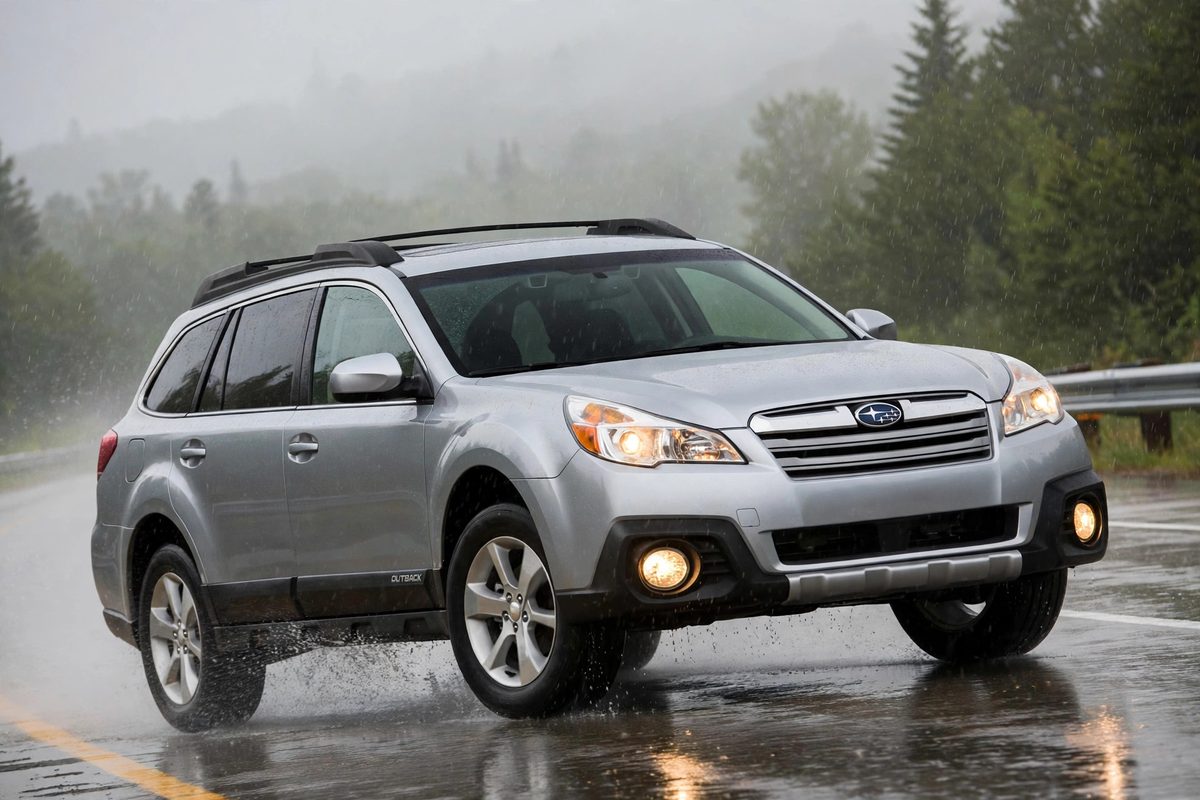
The 2014 Outback earned a 5-star overall safety rating from NHTSA and the IIHS Top Safety Pick+ rating, the institute's top award at the time. Standard equipment includes antilock disc brakes, stability and traction control, front side airbags, and side curtain airbags. Where the 2014 moves ahead of the 2013 is EyeSight: Subaru expanded its availability for 2014, bringing adaptive cruise control, pre-collision braking, and lane departure warning to more buyers, with a rearview camera available on CVT-equipped Premium and Limited trims. A 2014 with EyeSight is the closest a fourth-generation Outback gets to modern active safety, and it is worth seeking out.
Ownership Costs and Reliability: The Oil Consumption Warning
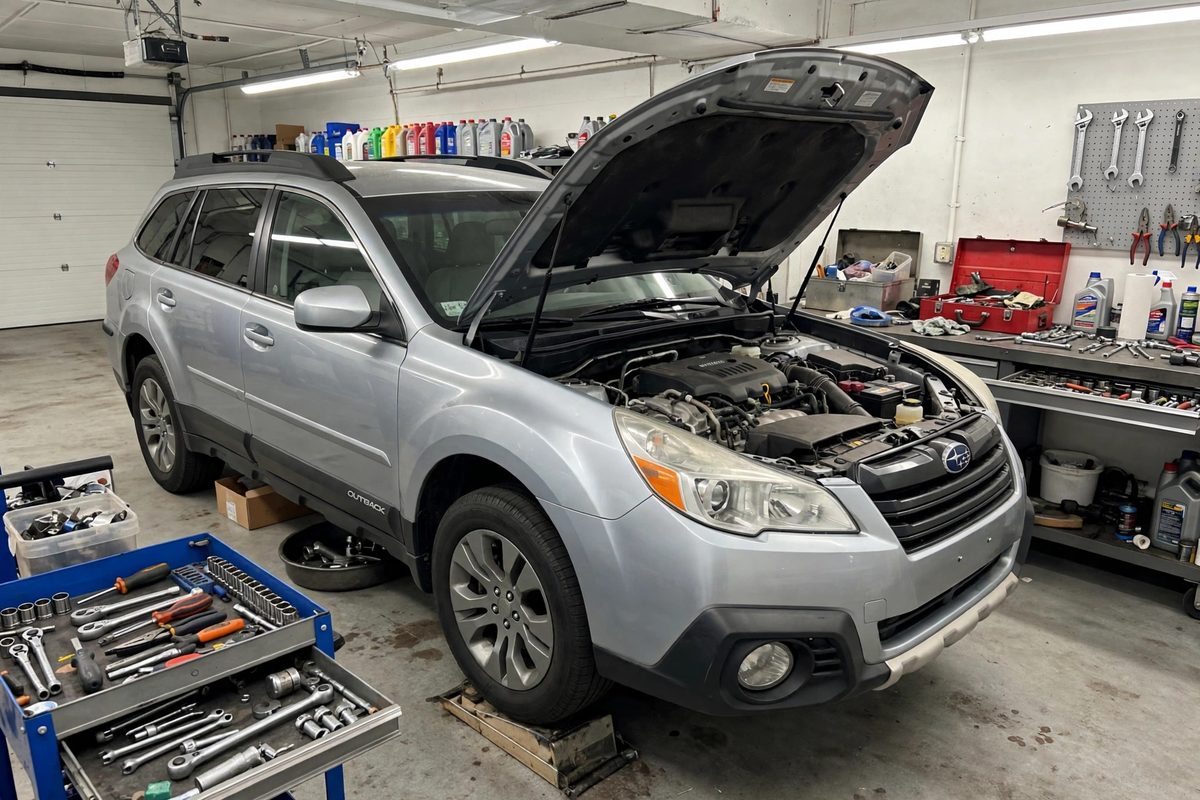
This is the section that decides whether a 2014 Outback is a bargain or a bill. Reliability guides report excessive oil consumption in the FB25 engine in the 2013 and 2014 Outbacks, linked to the engine's piston rings, and a class-action settlement extended warranty coverage for qualifying vehicles to eight years or 100,000 miles. That extension has now expired for a 2014, so any engine work today comes out of your pocket. These are reported patterns, not certainties — but the specific car's oil history matters more than the badge.
Two other checks belong on every 2014 shopping list. First, the early Lineartronic CVT: owner reports describe shuddering and hesitation, and reliability guides note inadequate CVT cooling under demanding conditions such as sustained climbs or towing, so a long test drive from a cold start is essential. Second, owner reviews flag electronics niggles — USB ports, radios, and infotainment faults — plus the generation's known annoyance of headlight bulbs that fail often and are awkward to replace through the wheel well. The recall record in the section below is the other half of this picture — and the reason a VIN check is the first thing to do, not the last.
Recalls and Owner Complaints: The Paper Trail
The 2014 Outback carries 10 NHTSA safety recall campaigns — the shortest list of any fourth-generation year (the 2010 had 18 and the 2013 had 12), and the clearest sign that Subaru had the generation sorted by its final year. Six of the ten are a single defect counted six times: the Takata passenger airbag inflator, recalled in two waves — January 2019 (19V-007, 19V-008 and 19V-009, one per climate zone) and January 2020 (20V-001, 20V-002 and 20V-003), the second wave re-recalling cars whose inflators had already been replaced once with an inflator of the same design. A 2014 can therefore show several Takata campaigns on its record and still need only one inflator replacement. The other four campaigns are the ones to check by name.
| Recall | Campaign | Date |
|---|---|---|
| Takata passenger airbag inflator (6 campaigns) | 19V-007/008/009 + 20V-001/002/003 | Jan 2019 – Jan 2020 |
| Wiper motor cover overheats, may melt | 16V-694 (Subaru WTK-71) | Sep 2016 |
| Electronic parking brake may not hold (manual trans.) | 18V-626 (Subaru WTV-81) | Sep 2018 |
| Ignition switch — engine may shut off while driving | 19V-297 (Subaru WUF-91) | Apr 2019 |
| 3.6R automatic transmission parking rod may detach | 13V-336 (Subaru WQJ-46) | Jun 2013 |
Two details are worth knowing before the VIN check. The 3.6R transmission recall (13V-336) covers only 2014 3.6R cars built between June 12 and June 28, 2013, with the five-speed automatic: the parking rod inside the transmission may come loose, so the car may not stay in park — or may not move out of it — and dealers replace the transmission free of charge. The ignition-switch recall (19V-297) is narrower than it looks: it covers cars with a mechanical key ignition switch installed as a replacement part, so a 2014 whose switch was never replaced may not be affected at all, and only the VIN record can say. The wiper recall (16V-694) supersedes an earlier campaign (11V-469), and cars fixed under the earlier one need the cover replaced again — a second visit for the same part, and another reason to check the record rather than assume.
The owner-complaint record is the best news in this post. NHTSA has 203 owner complaints on file for the 2014 Outback, the lowest total of the fourth generation, and The Weekly Driver scores the year 8.0 out of 10 on 68 powertrain complaints — again the best of the generation, against 6.9 for the 2010 and 6.0 for the 2011 — with no escalated NHTSA investigation on file for the generation. The complaint the year is still known for is the one this post already warns about: oil consumption on the FB25. Subaru's own bulletin on it (TSB 02-157-14R, August 2014) says confirmed cases get a new short block rather than new piston rings, and treats consumption above one quart per 1,200 miles as the threshold for a dealer visit. The Yaeger v. Subaru class-action settlement extended oil-consumption coverage to eight years or 100,000 miles, but that has now expired for a 2014, so a short block today is an out-of-pocket repair. That is the practical meaning of the paper trail: the recalls are checkable and free to fix, while the oil consumption is the risk you price into the offer — and on the 2014, the numbers say it is the smallest such risk of the generation.
Before you buy a used 2014 Outback, check these items
- ✓Check the oil level yourself, ask when it was last topped up, and ask for any oil-consumption test or engine repair records.
- ✓Drive from a cold start and feel for CVT shuddering or hesitation at low speed, and ask for documented CVT fluid service.
- ✓Confirm whether the car has EyeSight and test its adaptive cruise and pre-collision braking.
- ✓Test every USB port, the radio, and the infotainment screen before you agree a price.
- ✓Inspect the underbody and suspension for rust and worn wheel bearings.
- ✓Confirm all recalls are complete and favour cars with a full service history from a Subaru-experienced shop.
Pros
- Final, best-sorted year of the fourth generation, with wider EyeSight availability.
- Cheap entry point: about $8,350 to $10,150 to start by trim.
- Standard all-wheel drive with 8.7 inches of clearance for snow and gravel.
- Roomy cabin with 71.3 cubic feet of maximum cargo space.
- IIHS Top Safety Pick+ with a 5-star overall NHTSA rating.
Cons
- FB25 engine carries reported oil consumption risks, and the warranty extension has expired.
- Early CVT can shudder or hesitate, especially under hard use.
- Four-cylinder feels strained when fully loaded or at altitude.
- No CarPlay or Android Auto on any 2014 trim.
- Electronics niggles and fiddly headlight bulb replacement are reported.
Frequently Asked Questions
How much does a used 2014 Subaru Outback cost?▾
Kelley Blue Book's current dealer Fair Purchase Prices run from about $8,350 for the 2.5i Premium to about $10,150 for the 3.6R Limited, while CARFAX puts the average marketplace price at about $9,578.
What is the MPG of the 2014 Subaru Outback?▾
The 2.5-liter four-cylinder with the CVT is rated at 24 mpg in the city and 30 mpg on the highway, or 21 and 28 with the six-speed manual. The 3.6-liter flat-six is rated at 18 mpg city and 25 mpg highway.
Is the 2014 Subaru Outback reliable?▾
Consumer Reports rated the 2014 above average, better than the 2010 to 2013 cars, and owners rate it 4.67 out of 5 on CarGurus. Still, check the FB25's oil history and the CVT's behaviour carefully.
Does the 2014 Outback have EyeSight?▾
EyeSight was available on more trims for 2014, but not standard on every car — check the specific vehicle. It bundles adaptive cruise control, pre-collision braking, and lane departure warning.
Is the 3.6R Limited worth it over the 2.5i Limited?▾
For many buyers, yes: the six-cylinder costs only about $1,000 more used, adds 83 horsepower, tows up to 3,000 pounds, and uses a different engine without the FB25's oil consumption reports. The trade-off is 18 city and 25 highway mpg.
How many recalls does the 2014 Subaru Outback have?▾
NHTSA lists 10 safety recall campaigns for the 2014 Outback — the shortest list of the fourth generation. Six are the Takata passenger airbag inflator, recalled in January 2019 (19V-007/008/009) and again in January 2020 (20V-001/002/003) for cars whose inflators had already been replaced once. The others are the wiper motor cover (16V-694), the electronic parking brake on manual cars (18V-626), the ignition switch (19V-297) and the 3.6R transmission parking rod (13V-336). Run the VIN at nhtsa.gov/recalls — every recall repair is free at a dealer once completed.
What problems do 2014 Outback owners report most?▾
Oil consumption on the 2.5-litre FB25 is the top owner-reported problem, linked to the piston oil control rings; Subaru's bulletin 02-157-14R says confirmed cases get a new short block, and the eight-year/100,000-mile settlement coverage has expired, so repairs are out of pocket. The early CVT can also shudder or hesitate, and owners report electronics niggles. Even so, NHTSA has only 203 complaints on file for the 2014 — the lowest of the fourth generation — and The Weekly Driver scores it 8.0 out of 10, the best of the generation.
The Bottom Line
Buy the 2014 Subaru Outback if you want the most complete fourth-generation wagon: the same roomy, safe, all-weather package as the 2013, plus wider EyeSight availability and a better reliability record. The 2.5i Premium is the value pick, while the 3.6R Limited is the smart upgrade for towing and hill climbs. Walk away from any car that drinks oil, shudders from a cold start, or has no records. If it passes those checks, the 2014 Outback is one of the best-value wagons around $10,000.
Prices and specifications reflect Kelley Blue Book, CARFAX, Subaru, and CarGurus listings checked in November 2026; used prices change with mileage, condition, and location. Recall and complaint figures reflect NHTSA data checked November 19, 2026, and used prices reflect CarGurus national listings from November 16, 2026. Confirm a specific car's history and condition with an independent inspection before buying.
Continue researching the Outback
- Buying a Used Subaru Outback: Best Years, Prices & Checks
- 2013 Subaru Outback: Prices, Trims, MPG and Used Buying Guide
- 2015 Subaru Outback: Fifth-Gen Redesign Debut
- Subaru Outback Years to Avoid: Worst Years by Generation
- Subaru Outback Common Problems by Year & Repair Costs
- 2011 Subaru Outback: Prices, Trims, MPG and Used Buying Guide
- Cost of Subaru Outback: 2026 Prices, Trims and Ownership Costs
Sources
- Kelley Blue Book: 2014 Subaru Outback
- Kelley Blue Book: 2014 Subaru Outback Specs
- Subaru: 2014 Outback EyeSight and Safety Announcement
- CARFAX: 2014 Subaru Outback Research
- Samarins: Subaru Outback 2010-2014 Problems and Pros
- CarGurus: Used 2014 Subaru Outback Listings
- NHTSA: Check for recalls by VIN
- ConceptCarz: 2014 Subaru Outback Recall Information
A note on prices
Prices, trims, MPG figures and safety ratings change over time. Treat the figures here as a starting point and confirm the details with a dealer or the manufacturer's site before you buy.
Continue reading